
-
 By Anil Trivedi
- June 12, 2026
- 0 Comments
- Tire Industry
If you’ve been scrolling through social media recently, you might have noticed a wave of celebration and a healthy dose of confusion rippling through the Indian automotive and corporate sectors. RPG Group Chairman Harsh Goenka has been actively highlighting a monumental milestone: Indian tyre manufacturers have officially stormed the global elite.
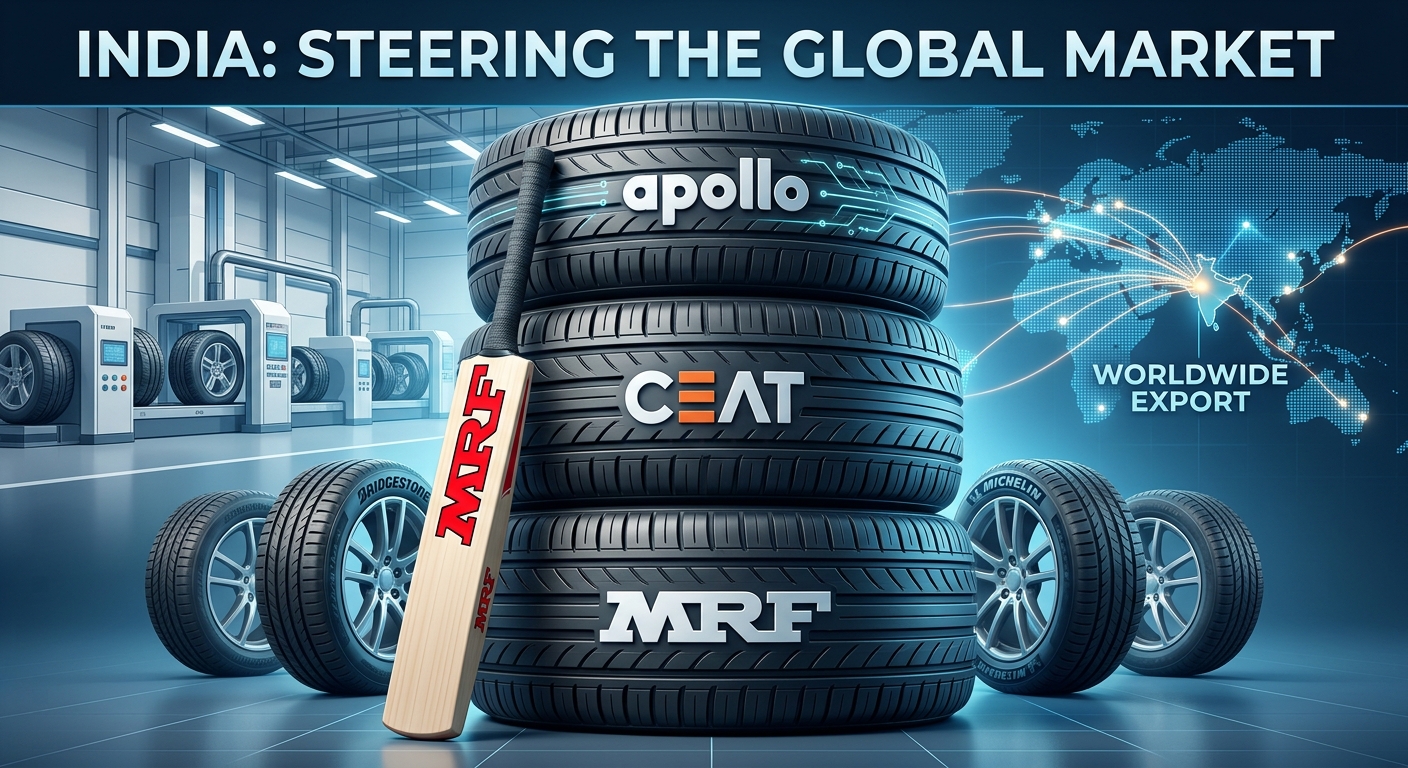
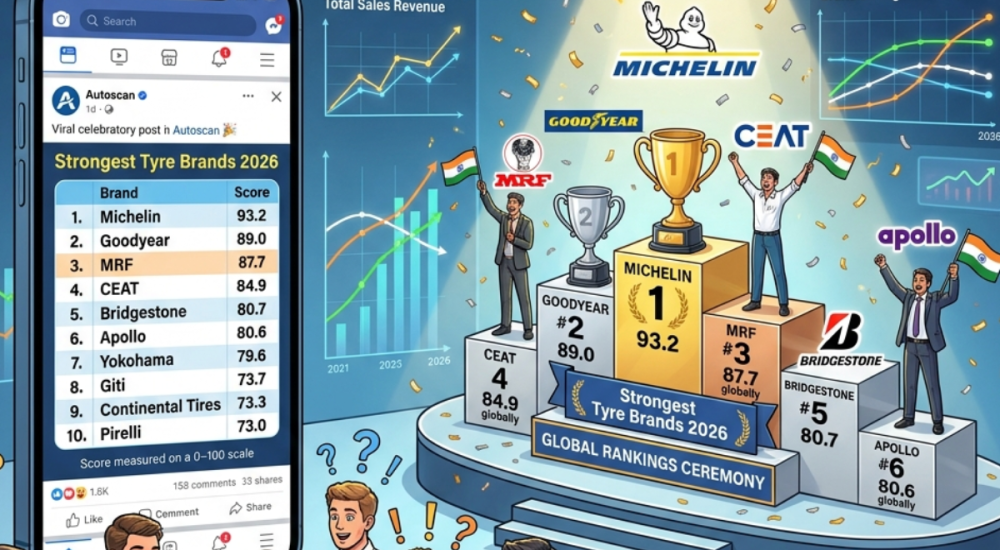
According to the Brand Finance Tyres 25 2026 report, three Indian corporate giants—MRF (#3), CEAT (#4), and Apollo Tyres (#6)—have claimed positions in the top 10 Strongest Tyre Brands in the world.
For many industry observers, the initial reaction was pure shock. How is CEAT ranking ahead of multi-billion-dollar legacy heavyweights like Bridgestone, Continental, and Pirelli? And where are industry powerhouses like JK Tyre or BKT?
To understand this historic shift, we have to look past total sales revenue and dive into how modern global brand equity is calculated, how macro-economic data drives the industry, and how digital Share of Voice (SoV) shapes consumer purchasing journeys.
The Metric Confusion: Brand Value vs. Brand Strength
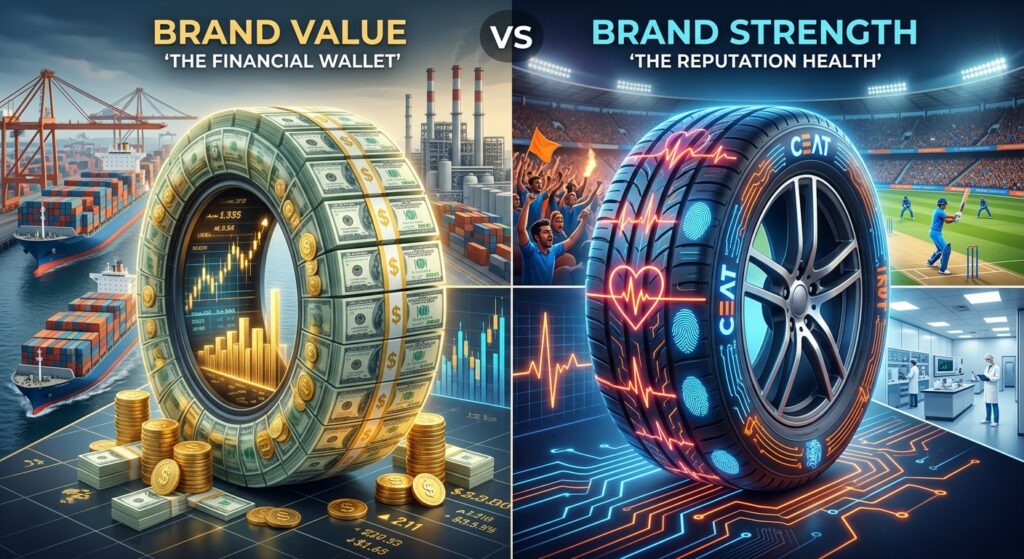
The skepticism surrounding the 2026 list comes down to a very common mix-up: mistaking Brand Value for Brand Strength. Brand Finance evaluates corporate brands using two distinct lenses:
Brand Value (The Financial Wallet): This is the estimated dollar value of the brand asset if it were licensed or sold. It is inextricably tied to total global revenue, massive manufacturing scale, and raw sales volume. On this front, the traditional hierarchy holds true: Michelin leads at USD 10.3 billion, followed closely by Bridgestone at USD 8.8 billion and Continental at USD 3.9 billion.
Brand Strength (The Reputation Health): This is determined by the Brand Strength Index (BSI), a balanced scorecard marked out of 100. It measures marketing investment, stakeholder equity (consumer trust, loyalty, and emotional preference), and future business readiness relative to the company’s operating scale.
This is exactly how CEAT edged ahead of Bridgestone on the BSI scorecard (84.9 vs. 80.7). While Bridgestone operates at a financial scale that dwarfs the Indian domestic market, CEAT and its Indian peers are generating superior marketing momentum, high consumer loyalty, and aggressive brand health relative to their size.
Macro-Economic Baseline: The Booming Indian Ecosystem
This massive brand momentum is supported by incredible domestic market growth. The Indian tyre market represents a highly lucrative sector within the broader automotive ecosystem, characterized by steady growth and high regional concentration.
The Market Infrastructure in Numbers:
Market Valuation (2025): USD 14.45 Billion, projected to climb to USD 27.67 Billion by 2034 at a CAGR of 7.49%.
The Radial & Tubeless Shift: Driven by high-speed highway networks, the market has seen a rapid structural shift, with the Radial segment commanding a 64% share and Tubeless configurations capturing a dominant 79% share of the market by 2025.
The Segment Mix: The replacement market dictates a massive 58% share of all sales, making direct consumer brand perception more critical than standard automotive factory partnerships
Regional Concentration & Search Focus:
This macro footprint is highly regionalized, telling brands exactly where they must focus their search engine optimization (SEO) and dealer marketing networks:
West & Central India (33.0%): The largest market volume, driven by industrial manufacturing hubs in Maharashtra and Gujarat.
North India (27.6%): Characterized by dense highway freight networks and high agricultural tyre demand.
South India (24.8%): Supported by localized automotive manufacturing bases in Tamil Nadu and Karnataka.
East India (14.6%): Driven primarily by heavy-duty mining and construction applications.
Why Indian Brands Swept the 2026 Scorecard
ndian tyre makers are no longer just domestic suppliers focusing on low-cost alternatives. They are scoring remarkably high on Brand Finance’s metrics due to three major strategic pillars:
Deep Emotional Equity and Local Trust
In India, tyres are an active purchase decision. Consumers seek hyper-specific engineering traits—puncture resistance, heavy load endurance, and structural durability tailored to demanding road conditions. This has created a highly distinct preference pattern. While global index leader Michelin leads local enthusiast polls (such as on Team-BHP with 53.4% of elite mindshare), domestic giants like Apollo, MRF, and CEAT command incredible consumer recall and brand safety scores among mainstream buyers.
High-Profile Marketing and the Digital Elasticity Benchmark
Indian brands have successfully decoupled themselves from the traditional “utility product” image. High-visibility campaigns, massive cricket sponsorships, and focused premiumization targeting luxury SUVs have dramatically elevated their awareness scores.
The digital tyre marketing landscape has proven to be incredibly elastic. For example, during the ICC Cricket World Cup, CEAT executed a high-impact digital video campaign across six regional language feeds on OTT platforms. The campaign reached 80 million viewers and generated over one billion impressions, translating directly into down-funnel consumer actions:
Triggered a 3x (300%) increase in direct organic website search queries.
Produced a 40% increase in direct digital dealer leads.
Secured up to an 18% lift in message association for its premium consumer tyre lines.
High-Margin Global Moves
The BSI heavily rewards forward-looking corporate strategy. The 2026 report specifically acknowledged bold structural moves: CEAT finalized a transformative USD 225 million acquisition of Michelin’s Camso brand, giving them global ownership of a premium off-highway business. Meanwhile, Apollo Tyres utilized its premium Vredestein brand to capture high-margin, elite European replacement markets, jumping to #6 globally in Brand Strength.
Addressing the Absences: Where are JK Tyre and BKT?
A common question arising from the 2026 report is why other prominent Indian manufacturing stars are missing from the top-tier headlines.
Why JK Tyre is Missing from the Top 10
While JK Tyre is a massive manufacturing engine with an extensive domestic footprint and robust commercial radial market share, Brand Finance only publishes a tight list of the top 25 global players. Breaking into the absolute top 10 requires an aggregation of global export-led brand equity, massive consumer retail perception scores, and high-margin international corporate value that JK Tyre is still scaling up to meet on a global index level. (In fact, JK Cement pitched a valiant effort for the same BCCI jersey rights but was outbid by Apollo).
Why BKT (Balkrishna Industries) is Not Listed
BKT is an absolute financial powerhouse with incredible profit margins, but it operates in a completely different ecosystem. BKT focuses exclusively on Off-The-Road (OTR) heavy industrial, agricultural, mining, and earthmover tyres.
Because Brand Finance’s mainstream scorecard relies heavily on passenger car vehicle consumer awareness, high-street replacement retail traffic, and mainstream automotive OEM partnerships, B2B niche giants like BKT are not tracked on consumer-facing brand equity indexes. You don’t buy a BKT tyre for a commuter hatchback, meaning it stays out of mainstream consumer brand studies despite its massive commercial success.
The Strategic Pivot: BKT and Birla Disrupting Mainstream Verticals
However, a massive shift is underway that will force consumer brand indexes to rewrite their scorecards. BKT has announced an ambitious modular expansion plan, stepping directly into the premium Passenger Car Radial (PCR) and Truck & Bus Radial (TBR) segments. Backed by a major capital program, BKT’s commercial vehicle radial lines are hitting the replacement market, with premium passenger car radial lines closely following. By targeting high-end consumer segments, this B2B giant is actively building the exact high-street retail visibility it previously bypassed.
Simultaneously, Birla Tyres is executing aggressive expansion strategies to scale its manufacturing footprint. This dual momentum established niche powerhouses entering high-volume consumer segments alongside legacy brands scaling up is structurally repositioning India from a regional manufacturing hub into a highly diversified, front-line global competitor across all vehicle categories.
The Rise of Design-Led Private Labels: The Acyuta Paradigm
This ongoing market reshuffle is opening doors for an entirely new breed of player on the global index: asset-light, premium private label brands. A prime example of this disruption is Acyuta, a brand changing the narrative by positioning itself not as a traditional manufacturer, but as a dedicated, design-forward engineering house. Co-engineered in collaboration with specialized design and knowledge partners like Team-Tire.com, Acyuta directly bypasses legacy capital-heavy production constraints to focus explicitly on real-world engineering and localized premium features.
Instead of competing purely on volume, private labels like Acyuta are targeting high-margin, high-spec consumer niches in PCR segments. They differentiate themselves through premium aesthetic and structural innovations—such as advanced 3D sipe geometry (intricate tread slits for better wet grip) for braking precision and specialized laser-engraved velvet sidewall finishes.
Furthermore, by integrating robust, digital-first consumer programs like their proprietary protection plan apps, these agile newcomers are building modern, deep customer equity at an accelerated pace. The rapid entry of private labels like Acyuta demonstrates that India’s path to global dominance isn’t just being paved by institutional giants; it is actively being redefined by high-IQ, design-first brands that know exactly how to target the modern, value-conscious consume
The Regulatory Import Bottleneck & Local Search Strategies
To fully understand the organic search landscape in India, one must look at the regulatory roadblocks introduced by the Directorate General of Foreign Trade (DGFT). To foster domestic manufacturing, the Indian government placed strict import restrictions on several categories of new pneumatic tyres.
Because high-volume, mass-market consumer tyre sizes (15-inch and 16-inch configurations like 195/55R16 and 215/60R16) are thoroughly served by domestic factories, international import licenses for these configurations are systematically denied. This has created an unprecedented digital battleground for international MNC brands operating in India:
The Michelin Supply Collision
Michelin commands exceptional premium equity, ranking first globally with a BSI of 93.2. Digitally, Michelin has launched highly viral campaigns, such as the #SafeOnMichelin and #IndiaDrivesChange initiatives, which combined reached over 140 million users by leveraging top-tier automotive influencers (like Gagan Choudhary) and major celebrities.
Furthermore, Michelin has turned professional networks specifically LinkedIn into a masterclass of corporate dominance. Their global LinkedIn strategy doesn’t just sell rubber; it projects thought leadership, sustainability milestones, eco-friendly compounds, and future mobility directly to automotive decision-makers, keeping their brand premium and insulated.
However, until recently, Michelin’s high online search interest faced severe local supply challenges due to the DGFT restrictions. Because they lacked a domestic high-volume passenger car plant, consumers searching for Michelin tyres frequently hit dead ends on dealer websites, causing search intent to redirect to competitors. To systematically eliminate this bottleneck, Michelin is investing INR 564 crore into its Chennai facility to establish local passenger car tyre production lines. Until this local manufacturing fully scales, their search presence remains highly focused on ultra-high-performance (UHP), large-rim sizes.
Bridgestone's Integrated Funnel Leader
Bridgestone India has capitalized heavily on local manufacturing, utilizing its massive plants in Chakan (Pune) and Pithampur (Indore) which rolled out its 100-millionth tyre in 2023 to pour out 27.7K passenger tyres daily. Managing a massive retail network of 3,153+ passenger car dealers, Bridgestone connects high-impact digital campaigns like “Feel the Bridgestone Difference” (featuring animal metaphors for grip and agility) and the “Zamana Badal Jayega” campaign (starring Vijay Raaz) directly to geo-optimized Google My Business (GMB) dealer pages. This ensures broad online awareness scales smoothly into direct, map-directed retail sales.
Yokohama's Hyper-Local SEO Mastery
While Bridgestone rules mass media, Yokohama India is the undisputed champion of bottom-funnel, hyper-local SEO conversion. Under strict intent-driven marketing, Yokohama avoids expensive cricket or television sponsorships entirely. Instead, backed by an $82 million Phase IV expansion at its Vizag plant, the brand has achieved an industry-leading 43% CAGR over two consecutive years. Yokohama focuses on optimizing its Yokohama Club Network (YCN) of over 550 exclusive stores. Each store maintains a hyper-localized GMB map listing, perfectly capturing consumers searching for “tyre shop near me” or “buy SUV tyres” within a 5-to-10 km radius, converting local search queries directly into retail sales.
The Fuel Behind the Growth: A Massive New Investment Cycle
This aggressive pursuit of global brand equity is backed by concrete, heavy-duty manufacturing infrastructure. Driven by near-peak capacity utilization (hovering between 85% and 90% across major players) and booming domestic and export demand, India’s tyre sector has entered an unprecedented capital expenditure cycle. The country’s largest manufacturers are pouring immense capital into expanding physical footprints:
JK Tyre has committed a massive roadmap, allocating over ₹4,900 crore toward phased brownfield expansions specifically aimed at scaling its PCR and TBR manufacturing capabilities by 24% across its Chennai and Mysuru facilities.
Apollo Tyres is aggressively deploying capital, with the vast majority earmarked for domestic capacity expansion alongside strategic scaling at its advanced plant in Hungary.
CEAT is similarly pushing forward with significant capital spending, scaling up upstream mixing facilities and expanding its industrial tyre divisions.
This massive wave of fresh investments signals that Indian manufacturers aren’t just building brand buzz they are building the raw industrial capacity required to sustain an aggressive global market share push.
The 2026 Verdict
The Brand Finance 2026 rankings show that the global tyre market is evolving at a breakneck pace. While the financial giants of Europe and Japan still hold the crown for absolute revenue, Indian manufacturers have successfully cracked the code for building world-class brand trust, agile corporate strategies, intense customer equity, and highly optimized digital funnels.
From dominating domestic cricket screens via historic corporate sponsorships to aggressive multi-million dollar global acquisitions, traditional B2B titans entering the passenger market, and design-first private labels rewriting production models, India’s tyre industry is no longer just following global market trends it is fundamentally preparing to steer them.